A Veteran Nurse Educator Reveals the Simplified, Illustrated System That Finally Helps Struggling Nursing Students Master Anatomy, Physiology, Pathophysiology, Pharmacology & Med-Surg — And Pass Their Licensing Exams With Confidence


It's 1:03 AM.
You have your Pathophysiology textbook open. Page 284. You've been on this same page for the last forty minutes.
You read a paragraph. You go back and read it again. You close the book, stare at the ceiling, and try to say it back to yourself.
Nothing.
Just blank space where the knowledge should be.
You open your phone. You type: "easy way to understand pathophysiology for nursing students." You've typed this exact thing before. Three times this week. The results are the same YouTube videos you've already watched. The same Reddit threads where someone asks the question and gets twelve different confusing answers.
You close the phone. You open the textbook again.
You are tired in a way that sleep won't fix.
Because here is the thing no one says out loud — the thing that sits heavy in your chest at 1am while your coursemates are asleep: You are scared that maybe you're just not smart enough.
Everyone else seems to just get it. They talk about cardiac output and compensatory mechanisms like they were born knowing these things. And I'm here reading the same sentence for the fifth time and still can't say it back in my own words.
You love nursing. You chose this. You want this more than almost anything.
But the gap between loving nursing and understanding its science feels... very, very wide right now.
Anatomy confused you because it felt like a senseless list. Bone names. Muscle origins. Nerve pathways. You memorized them the night before the test and forgot them by the weekend. Nobody showed you how the femur connects to the pelvis connects to the gait pattern of a patient who just had a hip replacement. Nobody drew you the picture.
Physiology felt like reading about a machine you'd never seen. Filtration rates. Action potentials. Hormonal feedback loops. Dense, technical, disconnected from anything you recognized as real life.
And then Pathophysiology came and threw everything upside down — because suddenly you were supposed to understand how things go wrong in a body you didn't fully understand when it was going right.
You failed it.
And here you are, repeating it. Sitting with the weight of that word — repeat — like a stone you carry everywhere and try not to let anyone see.
My parents sold land. They did that for me. And I'm sitting here at 1am unable to explain the renin-angiotensin-aldosterone system to myself.
Your coursemates are talking about licensing exams. NCLEX prep. Some of them are already talking about abroad — Canada, the UK, the USA. And you're nodding along, smiling, saying "Yes, me too" — while quietly wondering if you'll even clear this level.
You've tried everything. The thick textbooks that give you three pages of background before they get to the actual point. The YouTube videos that explain one concept beautifully and then leave you hunting across fifteen channels to find the next piece. Your coursemate's handwritten notes that made sense to her and look like a foreign language to you.
You even bought a PDF from a WhatsApp forward last semester — advertised as "nursing simplified." It was recycled lecture slides with smaller font. You felt cheated.
You are not stupid. You are not lazy. You are not the wrong person for this profession.
You just haven't been taught the right way yet.
Drop everything you are doing now and listen to every word I'm about to say.
"Because I'm about to share with you a simple, illustrated system that changed everything for nursing students who were right where you are now — and it starts with finally understanding why before trying to memorize what."
This method isn't new. It didn't come from a textbook publisher or a social media trend.
The best nurses I've ever known — the ones who passed their licensing exams on the first attempt, the ones who are now practicing in hospitals across three continents — didn't study harder. They studied differently. They understood that the human body is one connected story, not a stack of separate subjects. And once you see it that way, the pieces start to fall into place in a way that feels almost obvious.
That understanding has been quietly passed around hospital break rooms and nursing school corridors for years. Senior nurses sharing it with junior ones. Educators whispering it to the students they actually worried about losing. It never made it into the official curriculum. But the students who got it — they flew.
Hi. My name is Well-Versed Nurse.
First thing you should know about me: I am NOT a textbook publisher. I am not a university lecturer standing behind a podium reading from a PowerPoint.
I am a Registered Nurse Educator who has spent years watching brilliant, hardworking nursing students hit a wall — not because they lacked ability, but because the tools they were given were built for the wrong purpose. And I decided that was enough. I was going to package what actually works and make it available to every student who needed it.
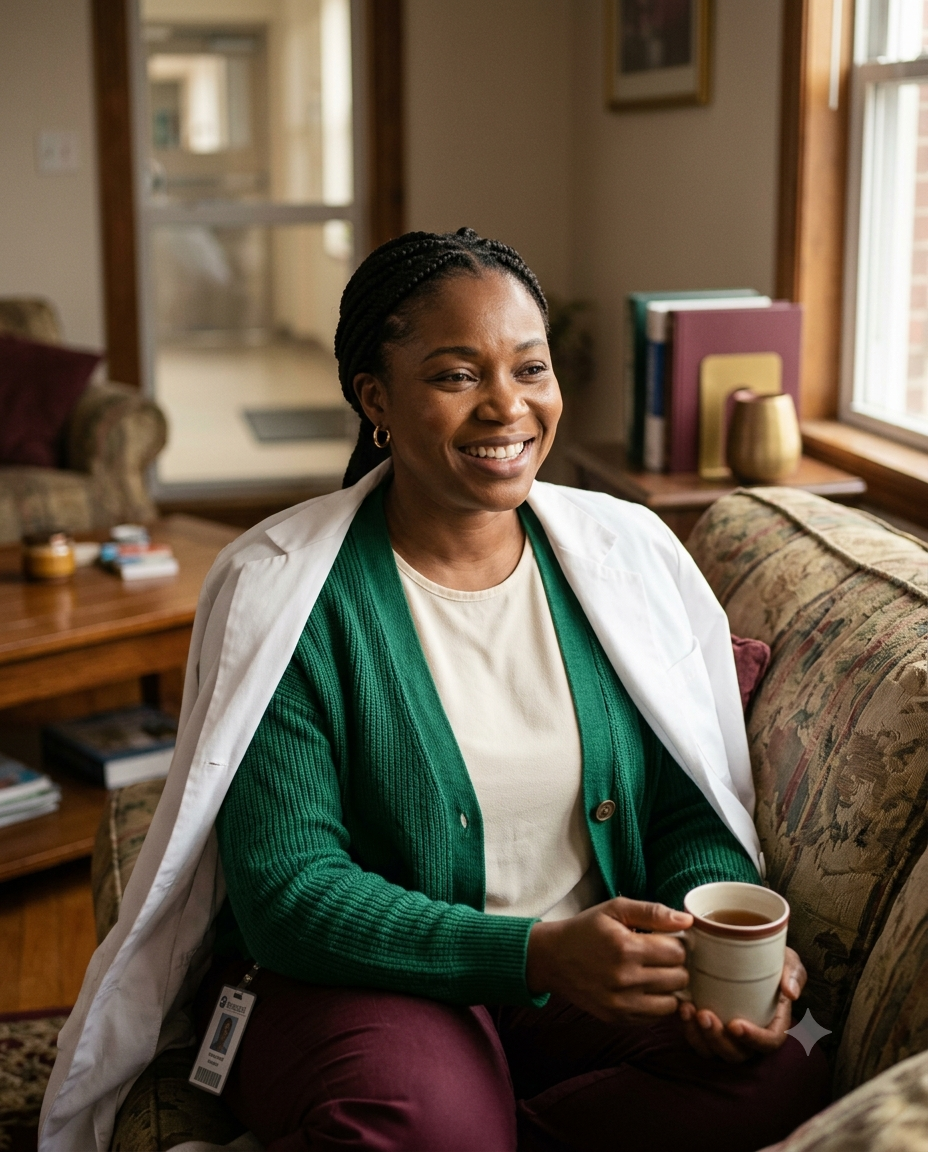
Let Me Tell You About Maureen.
I want to tell you about a student I met a few years ago. Her name was Maureen.
When Maureen started nursing school, she was the most hopeful person in her set. She had a plan. She had a vision — she wanted to be a Theatre nurse. She'd seen a surgical procedure done on a family member years ago and never forgot the quiet, precise confidence of the nurses in that room. That image stayed with her. It became her reason.
She passed her first year. Struggled in her second — but passed. And then 300-level hit, and Pathophysiology walked in the door.
"I read it for four hours," she told me later, in a voice that was trying hard to stay steady. "Four hours. And I still couldn't explain it back to myself."
She sat her Pathophysiology exam at the end of that semester.
She failed it.
Not by a wide margin. But enough to mean repeating. Enough to mean watching her set move forward without her. Enough to mean a phone call home to parents who had sold a piece of their land to pay for this program.
That phone call, she told me, was the hardest thing she'd ever done. Her father didn't shout. He just went quiet. And that silence was worse than shouting.
"Daddy, I'm sorry. I'll do better."
"We know you will, Maureen."
She hung up. She sat on the edge of her hostel bed. And for the first time since she'd started nursing school, she genuinely wondered whether she had made a terrible mistake choosing this path.
She tried everything she could think of to fix the problem.
She went back to Porth's Pathophysiology — cover to cover. It's a good textbook. It's thorough. It is also 1,800 pages long, written in prose that assumes you already understand the biochemistry it's describing. She lost the main point in the jargon every single time. By page 60, she was taking notes on notes and still didn't know what she actually needed to remember.
She turned to YouTube. She found some genuinely good channels. But they were scattered. One channel explained cardiac physiology beautifully but skipped pharmacology entirely. Another covered certain drugs but in a way that didn't connect back to the diseases. She spent more time searching for videos than actually learning from them, and she had to hold fifteen different explanations in her head simultaneously without a framework to organize them.
She borrowed a coursemate's handwritten notes. The notes were neat, detailed, clearly made by someone who understood the material. But they were organized for that person's brain, not Maureen's. She couldn't follow the logic. It was like being handed someone else's map of a city she'd never visited.
She tried group study. Four sessions. The first two were genuinely helpful. By the third, the group had fragmented — two people were debating a concept and getting each other more confused, one person had pulled out her phone, and someone had started venting about the lecturer. The fourth session Maureen left after thirty minutes because she felt she was learning backwards.
She bought a PDF from a WhatsApp group forward. "Nursing School Made Simple — Master Every Topic." ₦2,000. When she opened it, she found recycled lecture slides with clipart borders and no actual explanation of anything. She felt like a fool for having paid for it.
Is this just... what nursing school is? You read until your eyes hurt, you don't understand it, you pray on exam day?
She was exhausted. She was ashamed. She was, quietly, losing faith in herself.
The encounter happened by accident.
Maureen was at a small study gathering organized by one of her seniors — nothing formal, just a few students from different levels sharing coffee and notes in someone's flat near the school. She wasn't even going to go. She almost didn't.
I happened to be there that evening because the host was the daughter of a colleague of mine. I sat in the corner mostly listening.
But then I heard Maureen speaking. She was explaining, carefully and honestly, that she was repeating Pathophysiology. That she had been studying hard but felt like the information wasn't sticking. That she was starting to worry it meant something about her intelligence.
I leaned across and said: "Can I ask you something? When you study the kidney — do you start with structure, or do you start with what it filters, or do you start with what happens when it fails?"
She paused. "I... start wherever the textbook starts."
I nodded. That was the answer I expected.
"That's the problem," I told her. "The textbook was written to be complete. Not to be understood. Those are two different things. The kidney doesn't make sense when you meet it on page 487. It makes sense when you first understand what the body is trying to do — maintain balance — and then see the kidney as one of the tools the body uses to do it. Once you see it that way, the structure tells you the function. The function tells you what goes wrong in disease. The disease tells you what the drug is trying to fix. It's one story. You've been given it in pieces and asked to memorize the pieces without seeing the story."
The room had gone quiet.
Maureen was staring at me.
"So... the way I've been studying..."
"Is not wrong," I said. "But it's like trying to understand a film by reading a list of scenes in alphabetical order. The information is all there. The sequence is just completely wrong for how human understanding actually works."
She laughed — a surprised, slightly tearful laugh. "Okay but then how do I fix it?"
I pulled a sheet of paper out of my bag and drew her a quick diagram. A body system at the center. Structure branching off to one side. Normal function branching off another. Then dysfunction — what goes wrong. Then pathophysiology — why it goes wrong. Then pharmacology — what the drug does to interrupt or reverse the wrongness. Then clinical signs — what the patient looks like when all of this is happening in their body.
One diagram. Five branches. Every exam topic organized around the same skeleton.
"Learn every system like this," I told her. "Not topic by topic the way the textbook does it. System by system, the way the body actually works. The subjects stop being separate and start being one conversation."
She looked at that diagram for a long moment.
"This is the simplest thing anyone has ever shown me about nursing school," she said. "Why didn't anyone just... draw this at the beginning?"
That question stayed with me for a long time.
I'll be honest with you — Maureen didn't believe it would work. Not fully. It seemed too simple. She had spent months fighting with thousand-page textbooks, and the idea that a framework on a sheet of paper could change everything felt almost insulting to how hard she'd been working.
She went home, took out a fresh notebook, and tried the approach on the renal system. Structure first. Function second. Dysfunction — chronic kidney disease, nephrotic syndrome. Why it happens. What the kidney can't do anymore. What that means for the patient's fluid balance, blood pressure, electrolytes. Then the drugs — ACE inhibitors, diuretics, erythropoietin — and suddenly each drug made sense because she understood what problem it was solving.
She texted me that evening: "I don't think this is working yet. But I think I actually understand the kidney now?"
I wrote back: "That's the thing working."
She kept going. She did the cardiovascular system the same way. The respiratory system. She stopped trying to memorize facts and started trying to understand stories. And the facts began to stick — not because she forced them to, but because they had somewhere logical to live in her mind.
Three weeks before her repeat exam, she sat down to do a practice test.
She answered the first question and felt something she hadn't felt in months — she knew why the answer was what it was. She didn't guess. She reasoned. She could trace the pathophysiology from cause to effect and pick the answer that made sense in that chain.
She sat back from her desk and cried.
Not because she was overwhelmed. Because she finally felt like herself again.
She passed the repeat exam. Not barely — she passed well.
She went on to pass Med-Surg. She passed Pharmacology. She sat her Council exam and passed on the first attempt.
Then she registered for NCLEX. Her coursemates — the ones she had watched move ahead without her — were only just starting to prepare for it at that point. She sat the NCLEX in flying colours.
Today, Maureen is working as a registered nurse in the United States.
The other students at that gathering that evening — I shared the same framework with them. A girl who had been struggling with Anatomy finally understood why structures connect to functions. A young man whose Pharmacology notes were a sea of unrelated drug names suddenly had a system for organizing them. Within two months, I was getting messages from three of them about improved scores.
"I sent it to my sister who's in 200-level," one of them told me. "She said it changed how she studies completely."
Word traveled. Other students started asking. I could not see every person individually. I could not draw the diagram by hand for every student who needed it.
So I did the only sensible thing.
I built it properly. And I put it in a guide.
I put everything — the complete framework, the illustrated diagrams, the system-by-system breakdowns, the mnemonics, the exam strategy, the exact revision sequence — inside one simple guide.
Introducing...
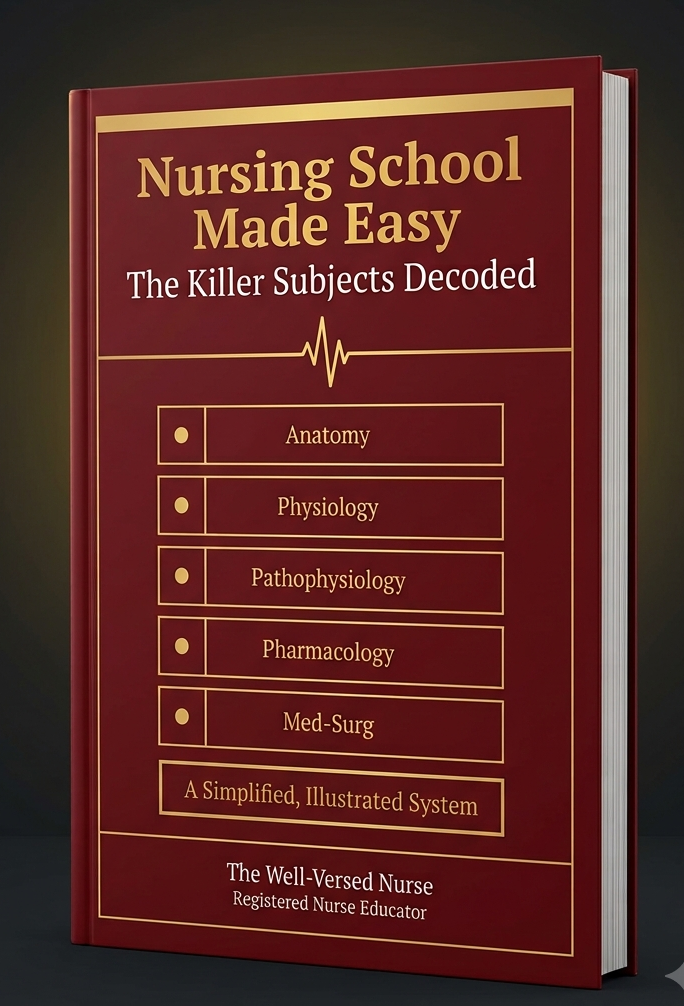
Nursing School Made Easy:
The Killer Subjects Decoded
A Simplified, Illustrated System for Anatomy, Physiology, Pathophysiology, Pharmacology & Med-Surg — Plus Your Complete Licensing Exam Success Guide
Inside This Guide, You'll Discover:
- The "Killer Topics" Master Checklist across all five subject areas — every high-yield topic you actually need to know for your exams, organized by subject so nothing slips through the cracks. Stop wasting time on low-priority content. — Pg. 6
- One-page mnemonic & memory anchor sheet per subject — with supporting icons and visual cues that make the most complex concepts impossible to forget. These are the memory tools that work because they make sense, not just because they rhyme. — Pg. 14
- The "Translate the Textbook" Cheat Sheet — dense medical jargon converted into plain, clear English, so you finally understand what the words actually mean before you try to apply them in an exam answer. — Pg. 22
- Structure-Function-Dysfunction visual maps for every body system — the illustrated diagrams that show you how normal anatomy connects to normal physiology, and how disruption of that physiology creates the diseases you study in Pathophysiology and manage in Med-Surg. One diagram. Five answers. — Pg. 31
- The 7-Day Exam-Week Revision Planner — a clear, prioritized sequence for your final week before any licensing exam. No guessing what to study when. No panic revision. Just a proven order that covers maximum ground in minimum time. — Pg. 68
- Self-test question sets per subject — designed to test your understanding, not just your recall. These questions mirror the reasoning style of Council and NCLEX exams, so you practice the right kind of thinking from day one. — Pg. 74
- Your complete Licensing Exam Success Guide — covering ICAN Council, NCLEX, and international registration preparation. The exact strategy for students who are studying in Nigeria but planning to practice abroad. — Pg. 86
Real Students. Real Results. ⭐
My coursemates thought I was exaggerating when I said I'd found something that made Pharmacology click. They now all have copies. The drug-class framework in this guide is unlike anything we were taught in class. I now understand WHY a beta-blocker does what it does — not just what it does. That difference is everything in an exam hall. This is the real simplified nursing resource, not those WhatsApp PDF scams.
I trained in Nigeria and I'm currently adapting my qualification for UK registration. I bought this guide to help me revise before my assessments and it was perfect — the content is clinically accurate, the language is clear, and the Licensing Exam section helped me understand how to approach the CBT style questions I was not used to. I recommended it to two other Nigerian nurses going through the same process. Both of them passed their assessments. Worth every penny.
I bought this for my NCLEX prep and I want to be clear — it is not just for students in Nigeria. The killer topics checklist and the 7-day revision planner helped me organize my studying in the final stretch before my exam. I passed on my first attempt. My study group saw my scores and asked what I was using. I sent them all the link. The Well-Versed Nurse really knows how to teach — she explains like she actually remembers what it felt like not to know.
I am a 200-level student and my senior recommended this to me. At first I thought it was too early for me to need it. Chai — I was wrong! Starting with the connected-systems approach this early has made my Anatomy and Physiology lecturers' explanations click in a way they never did in my first year. I wish I had this from day one of nursing school. My study group of five — we all bought it. It has become our foundation document.
Share Your Experience
Just So You Know... Putting This Guide Together Cost Me Far More Than What I'm Charging You.
- Professional clinical content writing and research review
- Expert medical accuracy verification by practicing RNs
- Custom diagram illustration and visual design production
- Professional PDF formatting and layout design
- Licensing exam content mapping and NCLEX framework review
I'm not going to charge you what it cost to produce this guide.
I won't charge you ₦50,000 — even though that would be fair.
I won't charge you ₦25,000.
Not even ₦15,000.
In fact you won't even pay the fair rate of ₦12,000.
Today, you're getting full access to the complete guide — plus your bonuses — for just:
₦12,000
₦8,800One-time payment. Instant download. No subscription. No hidden fees.
Also available internationally: $6.97 USD
⚡ This Introductory Price Will Not Last — Act Now ⚡
Instant download after payment · Secure checkout on Selar · Pay by card, bank transfer, or USSD
🎁 WAIT! I Have FREE Bonuses For You...
Order today and these powerful extras come with your guide — at absolutely no additional cost.
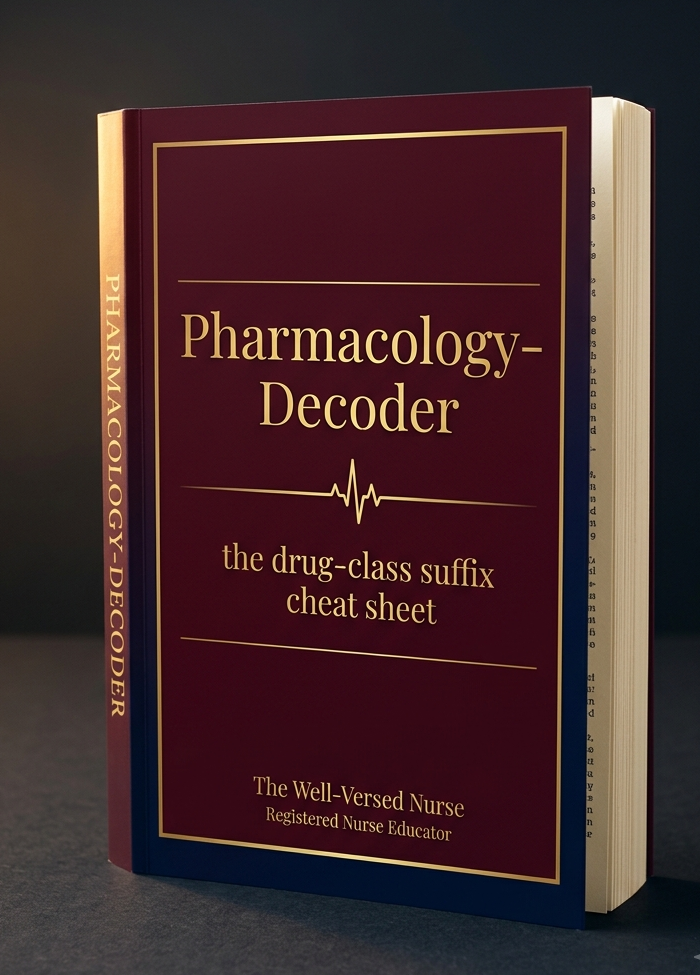
BONUS #1: The Pharmacology Drug-Class Decoder
A dedicated reference sheet that organizes the most commonly tested drug classes by mechanism of action, key nursing considerations, and exam-critical side effects — so you never confuse your beta-blockers with your ACE inhibitors again.
Value: ₦3,500 — Yours FREE today
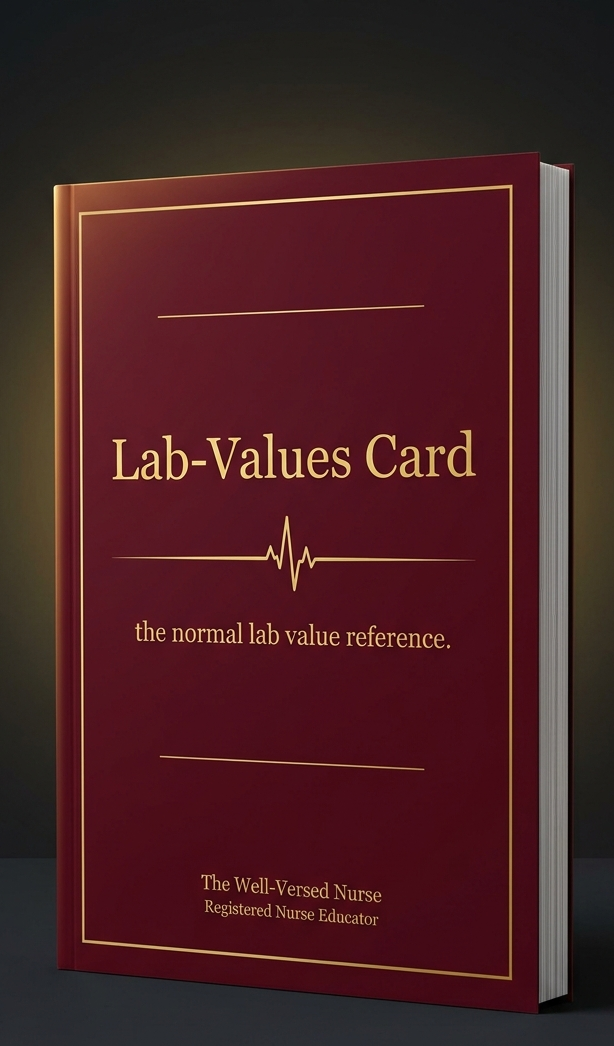
BONUS #2: The Normal Lab Values Quick-Reference Card
Every critical lab value you need to know for Med-Surg and licensing exams — organized by body system, color-coded by clinical significance, and formatted for fast revision. The one card you wish you had in every clinical rotation.
Value: ₦2,500 — Yours FREE today
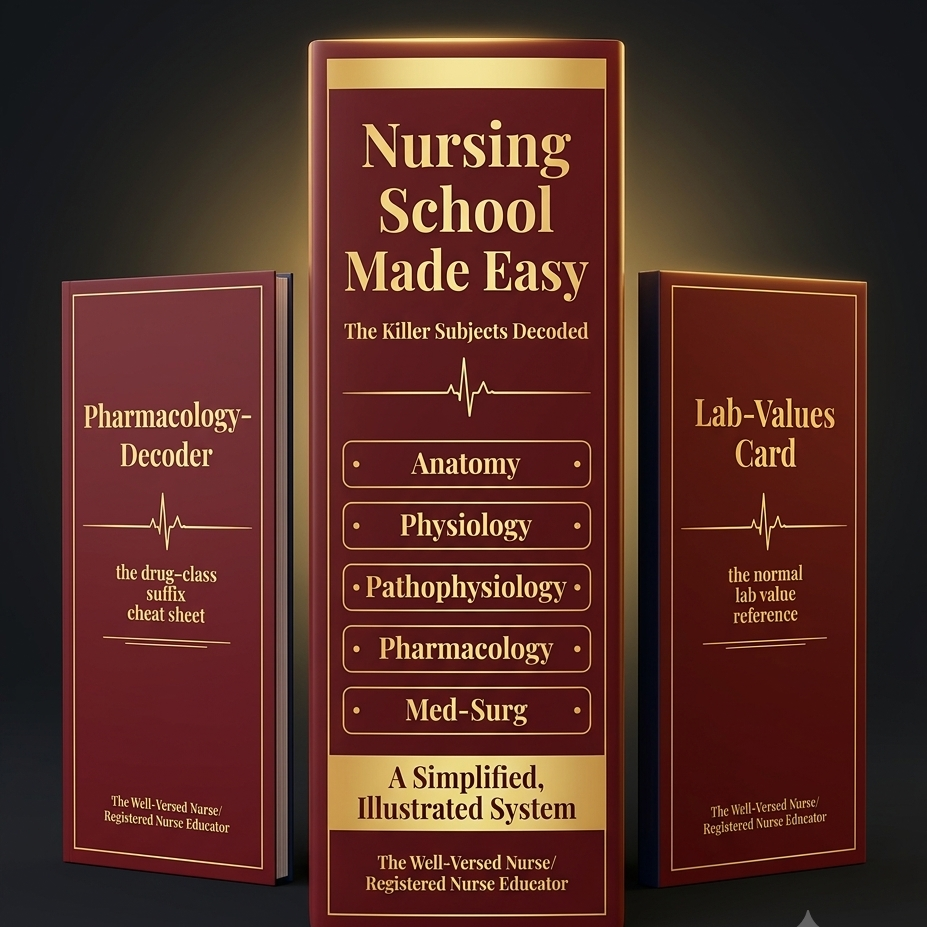
Main guide + Drug-Class Decoder + Lab Values Card · One payment · Instant access
See Who Else Just Got Their Copy 👇
Hundreds of students have already taken advantage of this introductory price...
And spots at this price are genuinely limited.
Bear in mind — you are not the only one viewing this page right now.
The student who acts first is the one who gets back to studying with a proper system, while others keep going in circles.
Secure checkout · Instant delivery · Available in Nigeria, UK, USA, and internationally
Still Feeling Unsure? I Totally Understand.
Which is why I'm making you a bold, risk-free promise:
Go through the guide. Use the diagrams. Work through the killer topics checklist. Apply the revision planner in your next exam preparation.
If you genuinely engage with this material and feel it has not given you a clearer, more organized, more confident approach to your nursing studies — reach out to me within 30 days of purchase and I will give you a full refund. No interrogation. No runaround. Just a straightforward resolution.
I am that confident in what I've built here. Because I've seen it work — not once, not twice, but consistently, across hundreds of students with different learning styles and different starting points.
The only risk is not trying it.
30-day guarantee · ₦8,800 one-time · Instant download
More Students. More Results. ⭐
I have been a nursing student for three years and nobody — not one lecturer — ever explained to me that Anatomy, Physiology, and Pathophysiology are telling the same story from different angles. This guide showed me that in the first twenty pages. I cried small tears of frustration that nobody had explained it this way before, and then I cried bigger tears of relief because now I finally understand. The mnemonics are brilliant. The visual maps are exactly what my brain needed. Buy this.
My sister bought this for me as a gift when she heard I was struggling with Med-Surg. I thought it would be like the other "simplified" guides — plenty of hype, no real content. But this one is different. The self-test questions alone are worth the price. They made me think like an exam question, not just recite facts. I'm now preparing for Council exam with actual confidence. First time since I started this program that I feel ready.
I trained in Nigeria and I'm now in Canada working through the bridging process for Canadian nursing licensure. The licensing exam section of this guide is genuinely helpful for internationally educated nurses — not just students. It helped me reframe how I think about exam-style questions. And the Pharmacology Decoder bonus is something I now keep open on my phone during ward rounds. Highly recommend to any Nigerian nurse planning to work abroad.
E no go make sense if I no give this testimony. I was in 300-level, failing Pathophysiology, ashamed to tell my family, crying every night. A friend sent me this page and I bought it on the last ₦9,800 I had that month. I prayed it would help. It did more than help — it transformed how I study everything. I passed my repeat. I'm now in 400-level and I just ordered extra copies for three of my juniors who are where I was. This guide is a lifeline.
I originally bought this for my daughter who is studying nursing in Nigeria. I'm a nurse myself (20 years in the NHS) and I was curious — so I read it too. I was genuinely impressed. The content is clinically sound, the language is accessible without being dumbed-down, and the illustrated system maps are exactly the kind of conceptual tool I wish had existed when I was training. I would have found this useful even at my level of experience. Excellent work, Well-Versed Nurse.
At This Point, You Have Two Choices.
OPTION 1:
Take action today. Get Nursing School Made Easy: The Killer Subjects Decoded. Start studying with a connected-systems framework that actually makes sense. Walk into your next exam knowing why the answers are what they are — not just hoping you memorized the right things.
Regain your confidence. Pass your exams. Build the career you chose this path for.
OPTION 2:
Close this page. Go back to the 1,800-page textbook, the scattered YouTube videos, the recycled WhatsApp PDFs that taught you nothing.
Keep spending hours studying and still not being able to explain it back to yourself. Keep wondering if you're "smart enough." Keep watching others move forward while you feel stuck.
Maybe God placed you on this page for a reason. Only you can decide what to do with it.
⏱️ The Clock Is Ticking. The Introductory Price Won't Wait.
Instant download · 30-day guarantee · One-time payment · No subscription
Honestly this guide saved my academic life. I was repeating Pathophysiology and I no longer understood what I was even studying for. The structure-function-dysfunction maps? E open my eyes like say na my first time truly understanding the body. I used this to prepare for my repeat exam and I passed — no more resit! God bless Well-Versed Nurse. If you are on the fence, please stop wasting time and just buy it.